
He expected to lose his appetite. Instead, the first change was much quieter: food simply became easier to stop.
My husband has been taking Mounjaro for two months.
We decided early on that if he was going to try it, I wanted to pay attention to what actually happened — not just what happened on the scale.
Because if you spend any time reading about GLP-1 drugs online, the stories can sound almost miraculous. People stop thinking about food. Their appetite disappears. They lose substantial amounts of weight.
Naturally, that was more or less what he expected too.
Two months in, his experience has been considerably less dramatic.
He hasn’t lost much weight yet.
He still gets hungry. He still enjoys food. And there was certainly no overnight moment when his appetite disappeared.
But something has changed.
And interestingly, the first thing to change wasn’t hunger.
It was his ability to stop eating.

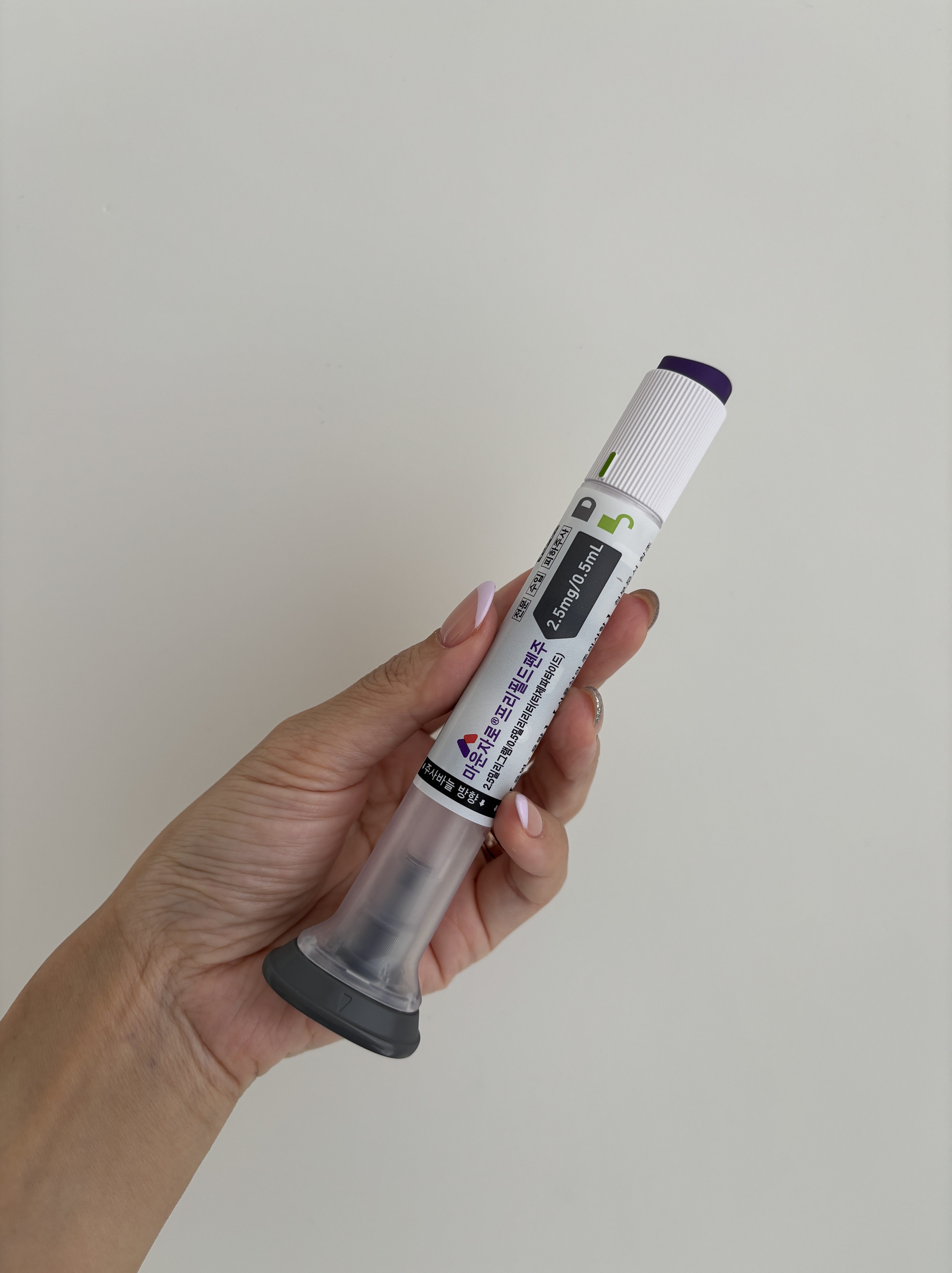
His first month on Mounjaro began at 2.5 mg once weekly.
The first two weeks: “I don’t really feel anything.”
He began with the 2.5 mg dose, injected once a week.
For roughly the first two weeks, his verdict was fairly uneventful:
Not much was happening.
He was still hungry. He still wanted food. Food still tasted good.
This was slightly disappointing to him because he had expected Mounjaro to make him not want to eat.
But sometime around the second week, he started describing something I found much more interesting.
Once he began eating, there seemed to be a point where the food simply became difficult to continue.
Not exactly:
“I’m so full.”
More:
“It just doesn’t really go in anymore.”
There was a new physical resistance to continuing the meal.
THE SCIENCE — Why might that happen?
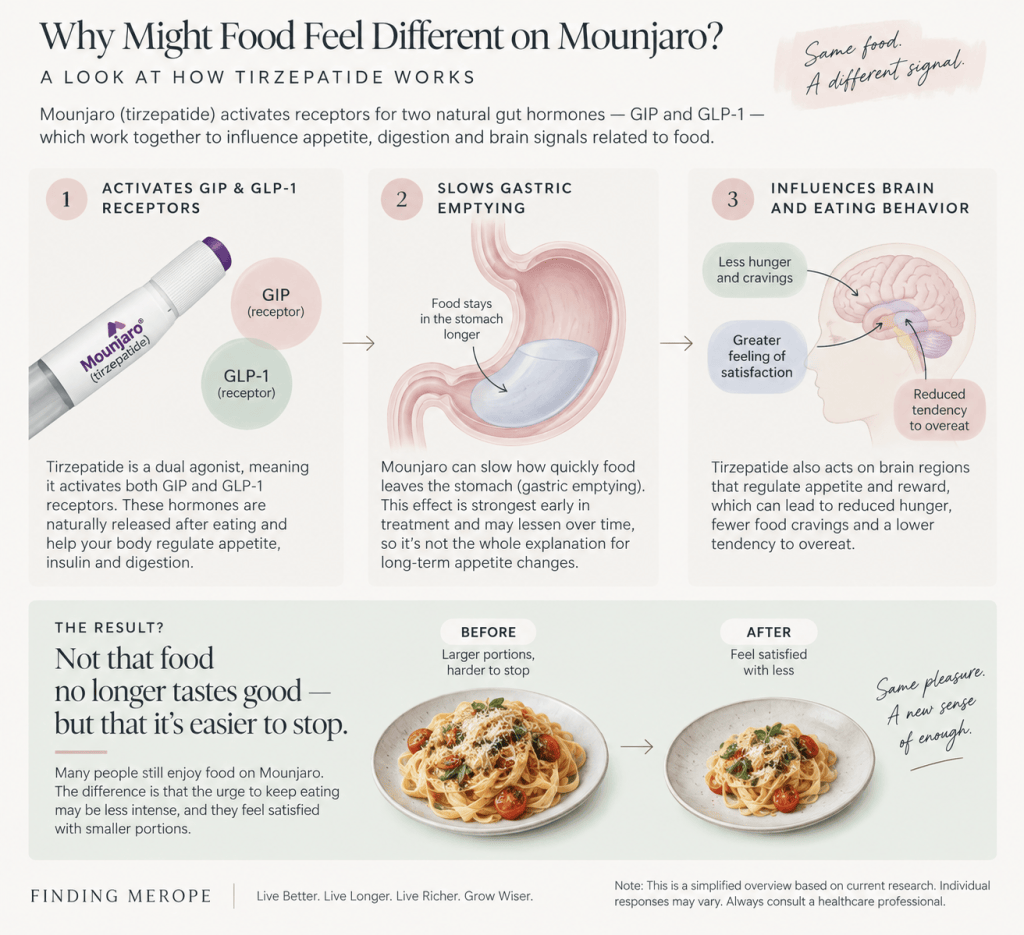
Mounjaro is the brand name for tirzepatide, which activates receptors for two gut hormones: GIP and GLP-1.
That distinction — fullness versus wanting to continue eating — turned out to be surprisingly relevant to what we were watching at home.

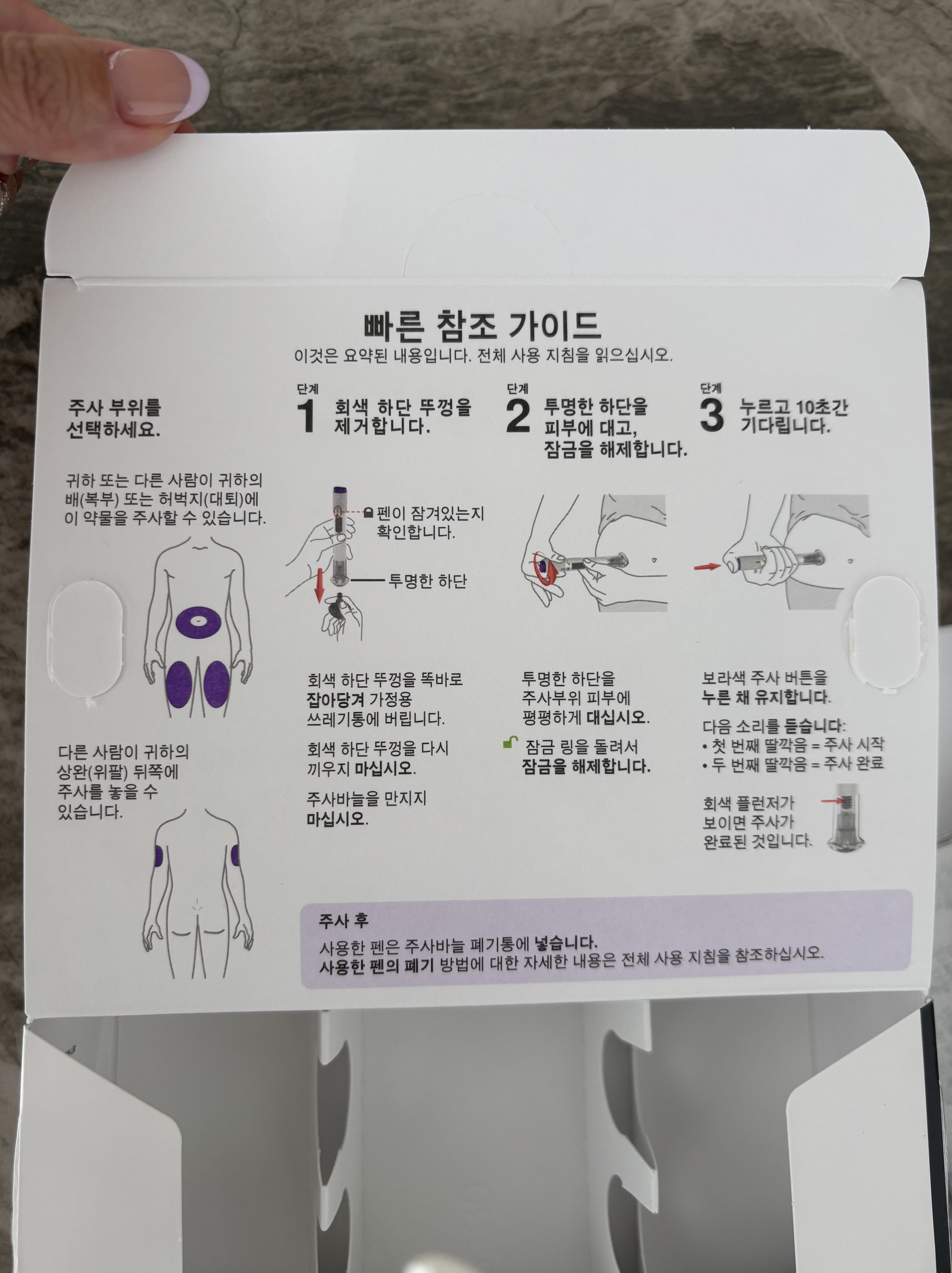
The Korean prefilled pen he used during his first month. Mounjaro is injected once weekly.
But habit didn’t disappear with the first injection
There was another layer to this.
My husband has always been a big eater.
Even when he began feeling this new resistance, he could still push through it and eat roughly the amount he was accustomed to eating.
His body might have been giving him a different signal, but his habits hadn’t caught up yet.
That made sense to me.
If you’ve spent years putting a certain amount of food on your plate and eating until it’s gone, a medication doesn’t instantly erase the behavioral part of eating.
By the third week, though, the resistance was getting harder to ignore.
He started eating less.
And the late-night impulse to find something else to eat began to fade.
Still, he didn’t describe himself as having “no appetite.”
And because appetite suppression was what he had expected, he wasn’t particularly impressed yet.
After the first four weeks at 2.5 mg, he moved to the next dose under his treatment plan.
THE SCIENCE — Why start so low?
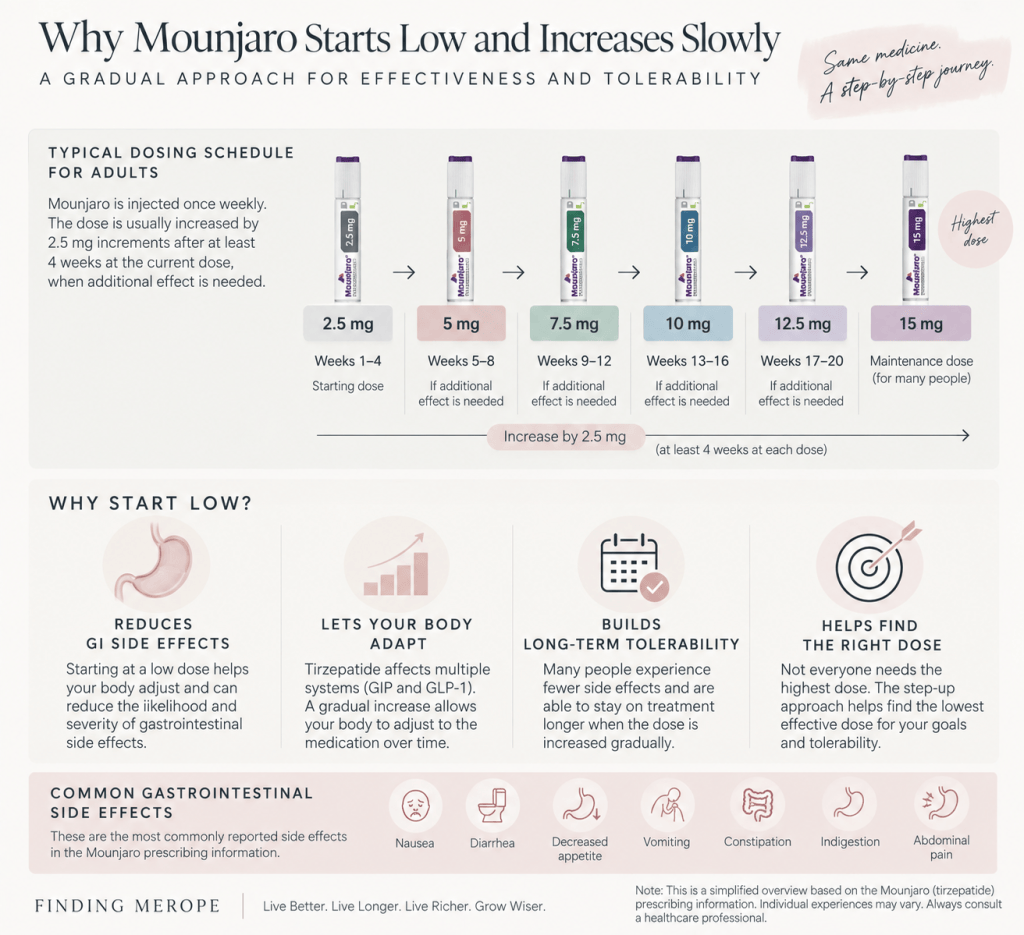
The gradual start is intentional.
So the first month isn’t necessarily the finished experience of the drug.
Month two: the change became much easier to see
The second month has been different.
The sensation that food simply doesn’t want to go in has become stronger.
But something else has happened too — something he didn’t immediately notice happening.
The urgency around food has started disappearing.
He explained it less as “I’m not hungry” and more as realizing that thoughts like:
“I want something else.”
“I need to eat.”
“What can I eat later?”
simply weren’t arriving with the same insistence.
He wasn’t consciously resisting them.
They had just become quieter.
And this is the part I can actually see.
What I noticed.
My husband has never been particularly graceful when hungry.
When he was really hungry, he could become irritable — sometimes impressively so.
And once food arrived, there was very little moderation. He could eat with an intensity that suggested the meal might be taken away from him at any moment.
Stopping at comfortably enough wasn’t really his thing.
Now I watch him eat an ordinary amount of food and… stop.
That’s it.
He puts it down.
His portions are becoming smaller. He looks for snacks less often. There is less urgency about when we’re going to eat next.
Most importantly, I don’t see him making a heroic effort to control himself.
There isn’t a visible internal battle of:
I really want this, but I shouldn’t.
He just seems to reach enough much more easily.
For someone who previously had almost no natural brake once hunger took over, that’s probably the most noticeable change I’ve seen so far.
THE SCIENCE — Is this the “food noise” everyone talks about?
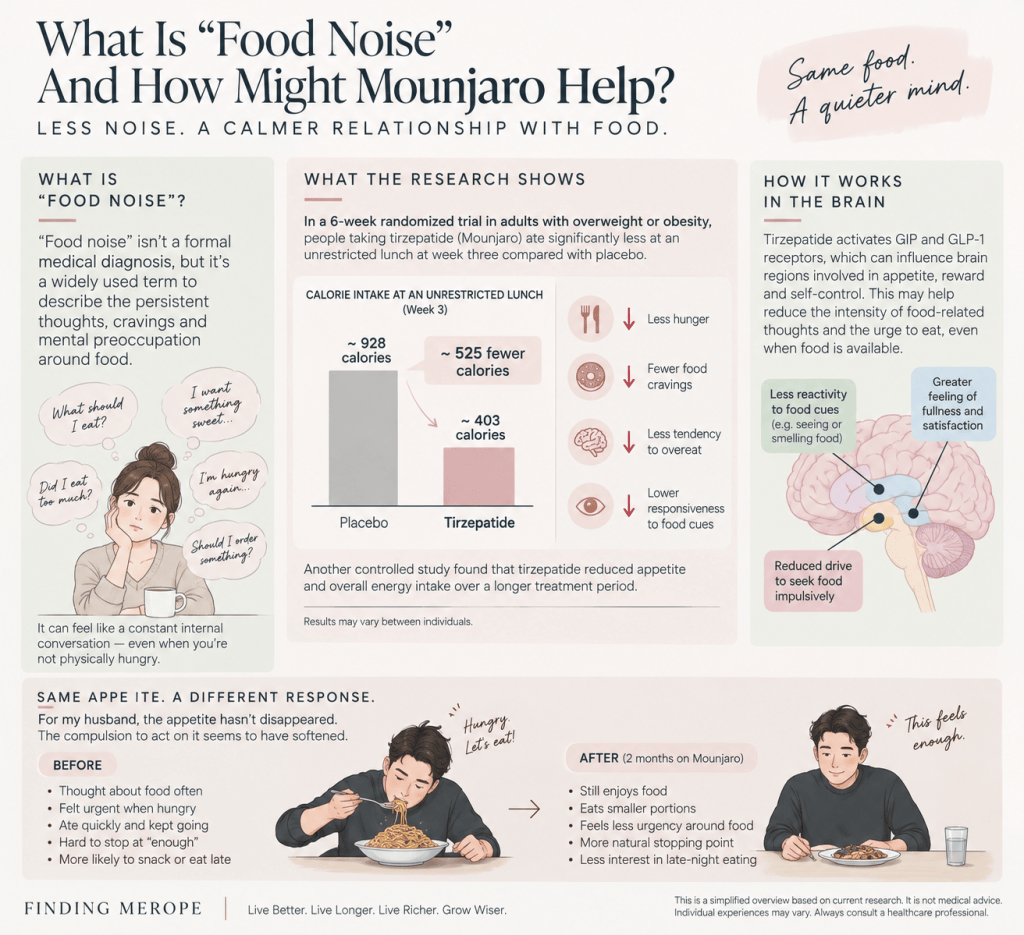
“Food noise” is not a formal medical diagnosis, but it has become a useful shorthand for persistent thoughts, cravings and mental preoccupation around food.
And there is some interesting evidence behind the phenomenon we’re observing.
That doesn’t mean everyone experiences the medication in the same way.
But it does make my husband’s description rather interesting.
His appetite hasn’t disappeared.
The compulsion to act on it seems to have softened.
Two months in, the most noticeable change hasn’t been the scale. It’s his relationship with hunger.
And yet, he hasn’t really lost weight
This is the part I particularly want to document because it isn’t the spectacular before-and-after story people tend to share online.
Two months in, he hasn’t lost a meaningful amount of weight yet.
He also hasn’t made a serious attempt to diet.
He isn’t counting calories.
He hasn’t dramatically increased his exercise.
And we’re not engineering every meal around weight loss.
So, for now, the most obvious result isn’t visible on his body.
It’s visible at the dinner table.
I actually find that more interesting than I expected.
Because before he started Mounjaro, I assumed we’d be watching kilograms.
Instead, I’ve spent two months watching appetite become something that appears increasingly manageable rather than commanding.
What happens next?
We’re still very early.
Maybe the weight loss will follow.
Maybe we’ll eventually need to pay much more attention to what he’s eating, how much protein he’s getting and whether he’s preserving muscle as his intake decreases.
And the experience may change again as treatment continues.
I don’t want to turn two months of one person’s experience into a conclusion about Mounjaro.
It’s simply our observation so far.
But if you asked me what Mounjaro has changed after two months, I wouldn’t say:
It made my husband stop eating.
I’d say:
It seems to have given him a pause between wanting food and needing to eat it.
And for someone who used to get angry when he was hungry, inhale a meal once it arrived, and immediately think about what might come next…
that’s actually quite a change.
We’ll see what Month Three brings.
The Two-Month Mounjaro Diary
| Our experience so far | |
|---|---|
| Time on Mounjaro | 2 months |
| Starting dose | 2.5 mg once weekly |
| Month 2 | Dose increased under his treatment plan |
| Hunger | Still present |
| Food enjoyment | Still present |
| Portion size | Noticeably smaller |
| Late-night food seeking | Reduced |
| Urge to keep eating | Significantly reduced |
| Weight change | No meaningful loss yet |
| Structured diet | No |
| Major exercise change | No |
| Most noticeable change | Food feels less urgent |
This article documents one person’s experience and is not medical advice. Mounjaro (tirzepatide) is a prescription medication. Individual responses, appropriate dosing, contraindications and risks vary, and treatment decisions should be made with a qualified healthcare professional. Current prescribing information lists gastrointestinal adverse reactions among the most common side effects and contains additional important warnings and contraindications.


Leave a comment