On our last full day, we left the resorts behind and followed the coast through places where there was surprisingly little to see — and an extraordinary amount to taste.
By the third morning, I thought I had more or less understood what I liked about Niseko in summer.
The previous two days had been wonderfully uncomplicated: a beautiful hotel, an onsen, golf beneath the mountains, good food and the peculiar luxury of having fewer things demanding my attention. I had come expecting a pleasant escape from the heat and discovered that Niseko’s emptiness outside ski season was not something that needed to be compensated for. I was already quite content with that conclusion.
Then, on our final full day, we left the polished world of Niseko’s resorts behind.
We set off at eight in the morning for an all-day drive through the wider region, passing through Kutchan and Moiwa before heading west towards Kamoenai, Shakotan and Furubira, eventually continuing south towards Yoichi. It was an eight-hour itinerary, finishing around four in the afternoon, and our guide described the theme of the day with appealing simplicity: eat and heal.
It sounded almost too vague to qualify as an itinerary.
As the day unfolded, I began to understand exactly what she meant.
A landscape that wasn’t trying to entertain us
Our guide was unusually candid about the places we were going to see. Shakotan was an established destination, but much of the rest of the route wasn’t really tourist country. If you asked what there was to see, she said, there wasn’t always a very convincing answer. There were local landmarks, oddly shaped rocks and stories attached to them — the sort of attractions that sometimes feel as though a town has looked around at what it has and decided something ought to become a sight.
What the region did have, she told us, was food.
As we drove, she seemed to map western Hokkaido not through monuments but through things that grew there. One area was known for cherries, another for strawberries; then came potatoes, corn, watermelon and melon. The geography gradually became edible.
Perhaps because of the way she explained it, I stopped looking outside the window for attractions and started noticing signs of ordinary life instead. We passed small fishing ports where boats were tied up rather than picturesque beaches arranged for visitors, and stretches of coast where local families had come down with their children to barbecue and spend the day by the water.
There was something profoundly relaxing about seeing a coastline being used rather than presented.
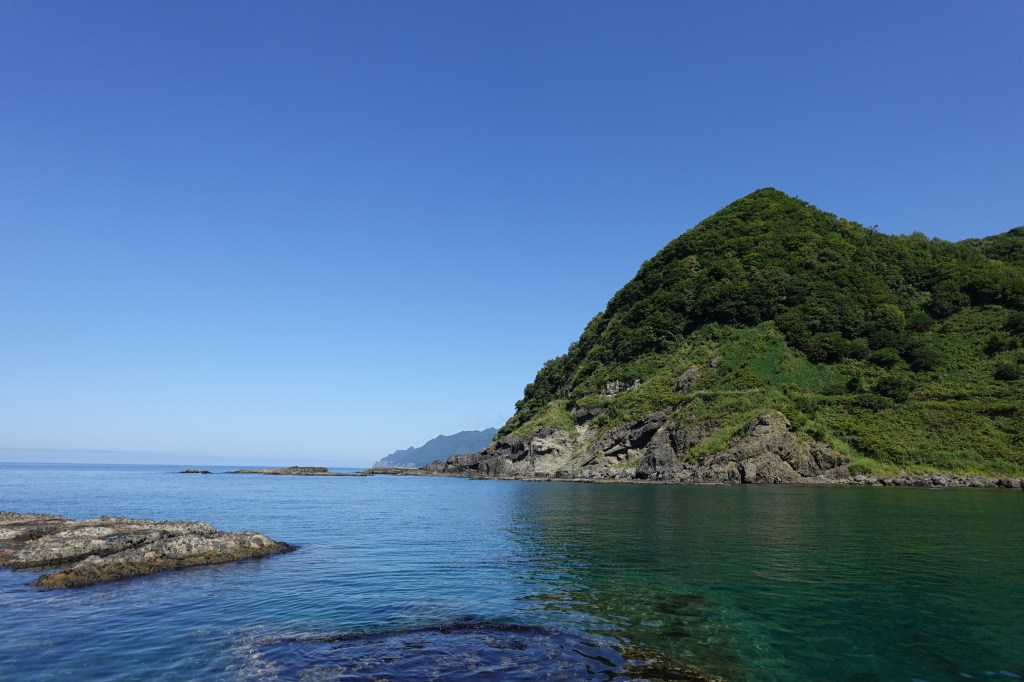
The sea itself was extraordinary in places, shifting from dark blue into clear green close to shore, but the beauty felt incidental to the life around it. People were swimming, fishing, eating and talking. Nobody appeared particularly concerned with whether the scene was impressive enough.
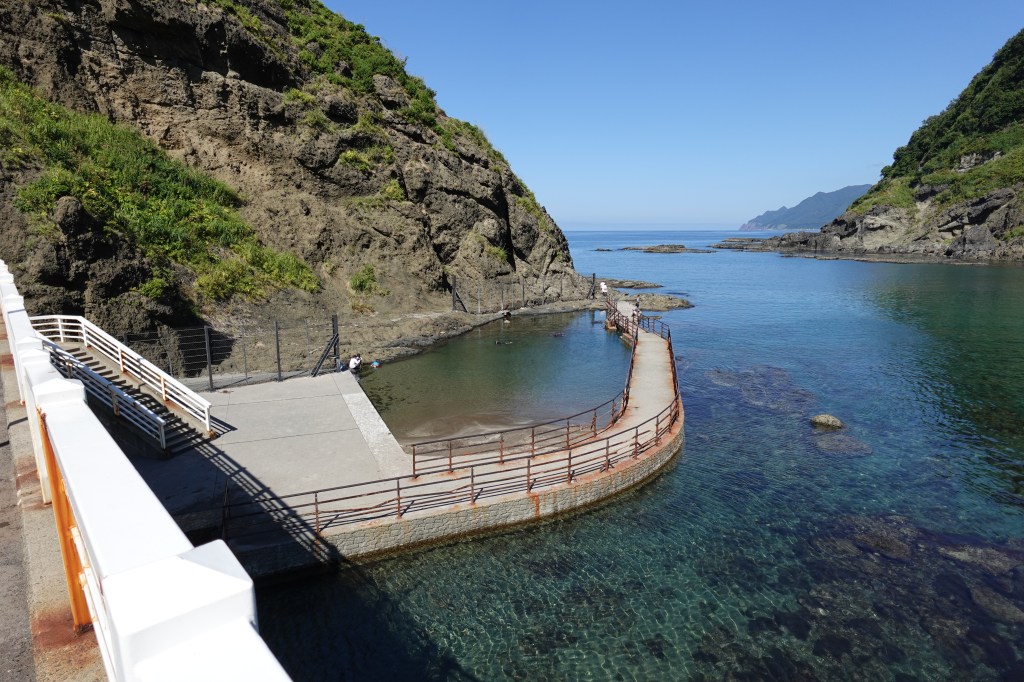
After two days in one of Japan’s most internationally recognisable resort destinations, this felt like another Hokkaido entirely.
Or perhaps it was the Hokkaido that had been there all along.
Shakotan, and a story at the edge of the sea
Shakotan was the obvious exception to the day’s relative lack of tourism.
The peninsula projects into the Sea of Japan and is famous for the intense blue of its water — the colour is so closely associated with the area that it is commonly called Shakotan Blue. At Cape Kamui, a narrow path runs along a dramatic ridge towards the sea, with steep cliffs falling away on either side.
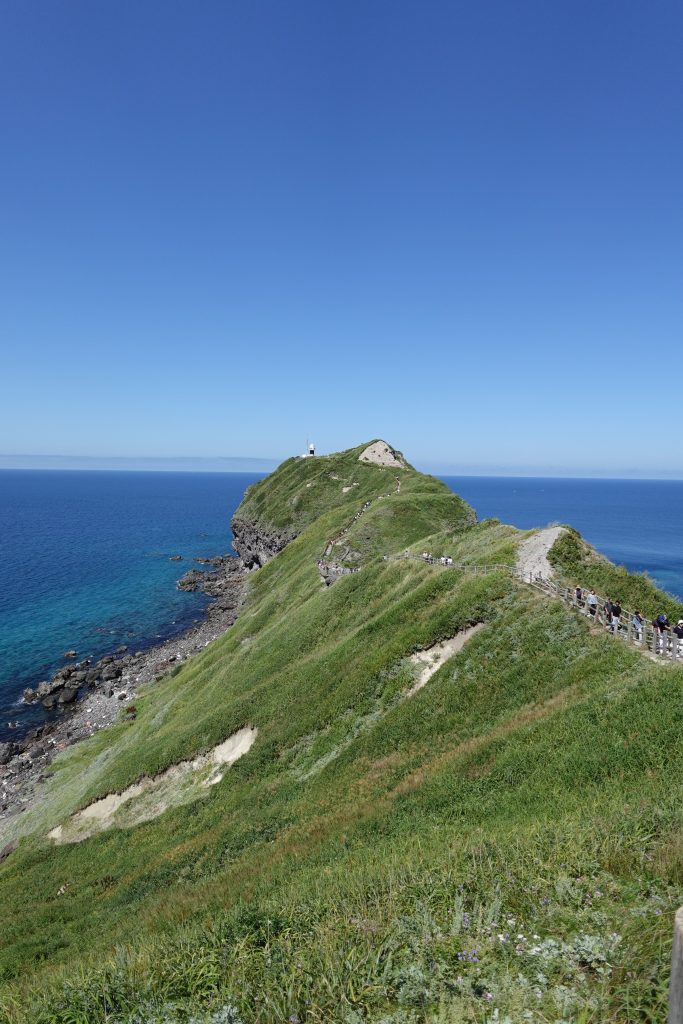
There is also an old prohibition attached to the place. For centuries, women were traditionally forbidden from entering Cape Kamui, and a sign marking the former restriction still survives near the entrance. The story is commonly connected to the legend of Charenka, an Ainu woman whose grief and jealousy were said to have brought misfortune to ships carrying women past the cape.
Like many legends that survive long enough, history and storytelling have become entangled.
Our guide offered a much more practical modern interpretation that I found almost more interesting: Cape Kamui is exceptionally exposed to wind, and the narrow trail can be physically demanding in bad conditions. Perhaps, she suggested, what became encoded as prohibition and legend also contained an older instinct about danger.
Whether or not that explanation accounts for the tradition, standing there made the possibility feel less absurd. The landscape is beautiful precisely because it is so exposed — a thin green ridge reaching into an enormous blue sea, with almost nothing to interrupt the wind.
I didn’t feel the need to untangle the legend completely. Some places carry stories partly because the geography itself seems to invite them.
Then someone handed me an ear of corn
The most important food I ate that day did not come from a famous restaurant.
It came wrapped in plastic.
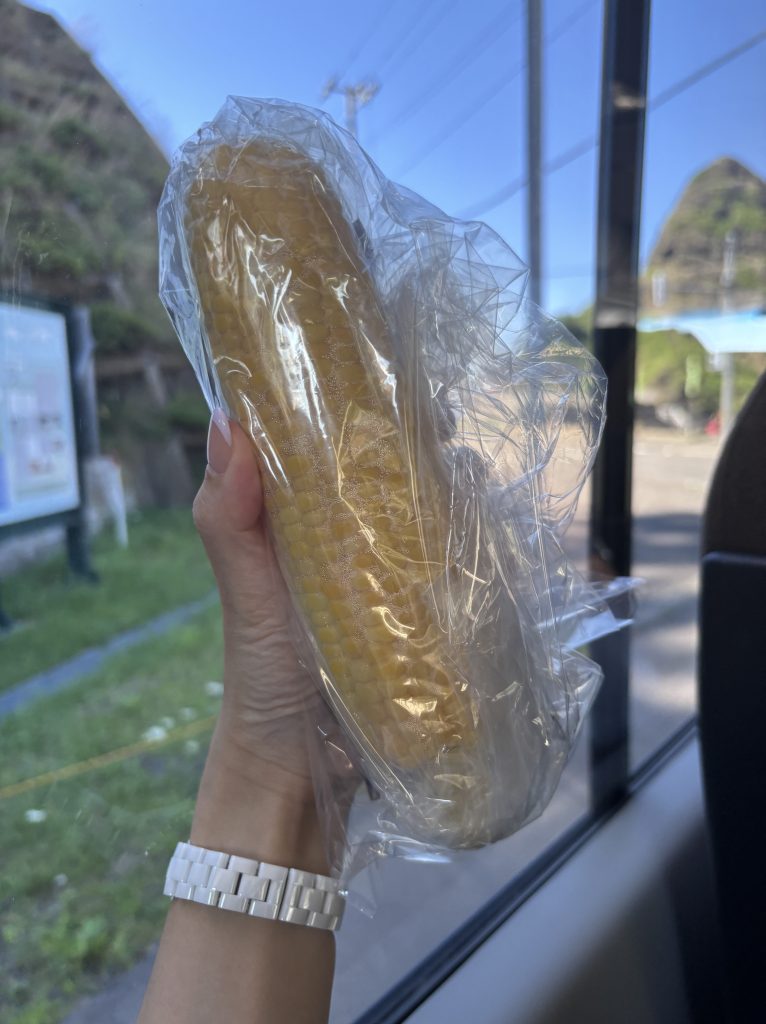
Our guide had brought a large box of corn that had been steamed at the resort that morning. Nothing had been added, she told us. No sugar, no seasoning, just water.
I didn’t believe her at first.
The corn was so sweet that my immediate assumption was that someone had sweetened it. Yet it didn’t have the blunt sweetness of added sugar. It was intensely sweet but still unmistakably corn: milky, juicy and almost creamy, with the deeper roasted, earthy flavour of the grain underneath. The closest comparison I could think of was an unusually sophisticated cotton candy, except that the sweetness was anchored by something savoury and vegetal.
It was ridiculous to be that surprised by corn.
And yet I was.
I didn’t even manage to finish mine before my husband took the rest. There had been enough in the box for roughly fifteen people on the tour, and it disappeared so quickly that even our guide seemed surprised by the reaction.
That ear of corn rearranged something in my mind.
Until then, I had been eating extremely well in Hokkaido, but I had attributed much of it to the obvious explanation: we were staying at an expensive resort with very good chefs. Of course the vegetables were excellent. Of course dinner was beautifully balanced. Of course breakfast tasted clean and carefully prepared. That was what a good hotel was supposed to do.
The corn removed the chef from the equation.
If something this simple, cooked in water and handed to me in a plastic bag, could taste like this, then perhaps I had misunderstood what I had been eating for the previous two days.
The quality wasn’t being created entirely in the kitchen.
Much of it had arrived there already.
Japan’s northern pantry
Hokkaido is often described as Japan’s food basket, and the phrase can sound like tourism copy until you begin eating your way through the island.
Its scale, relatively cool climate and agricultural land allow Hokkaido to produce an extraordinary share of Japan’s dairy, potatoes, wheat and other crops, while the seas surrounding the island supply crab, scallops, salmon, squid, kelp and sea urchin. The relationship between place and food is unusually visible here because so many ingredients considered special elsewhere are simply local.
That afternoon, I began mentally replaying the meals we’d already eaten.
The vegetables at breakfast. The beef. The potatoes. The dairy. The dishes at MUWA that had seemed remarkably restrained.
I had admired the cooking, and rightly so, but suddenly I understood the restraint differently. When ingredients arrive with that much character, doing less to them isn’t minimalism for aesthetic effect. It can simply be good judgment.
And then we reached lunch.
The uni that explained uni
The restaurant was in Furubira, and there was very little about it that suggested destination dining. It wasn’t filled with international tourists who had travelled across Hokkaido following a restaurant list. The room was overwhelmingly Japanese, the atmosphere local and unceremonious, the kind of place people appeared to visit because they knew what they would get there.
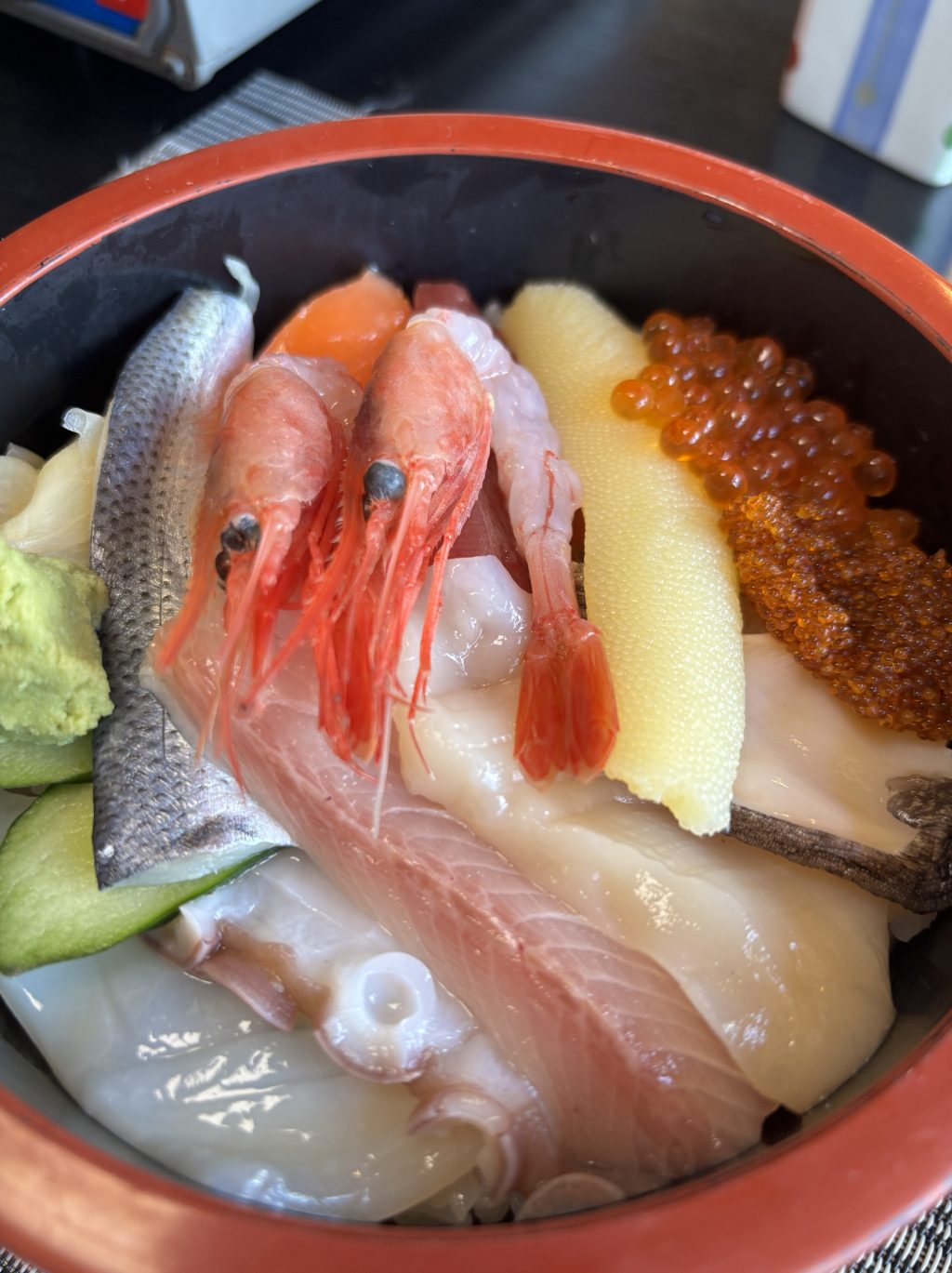
We ordered chirashi bowl and a white-miso Nabe hot pot.
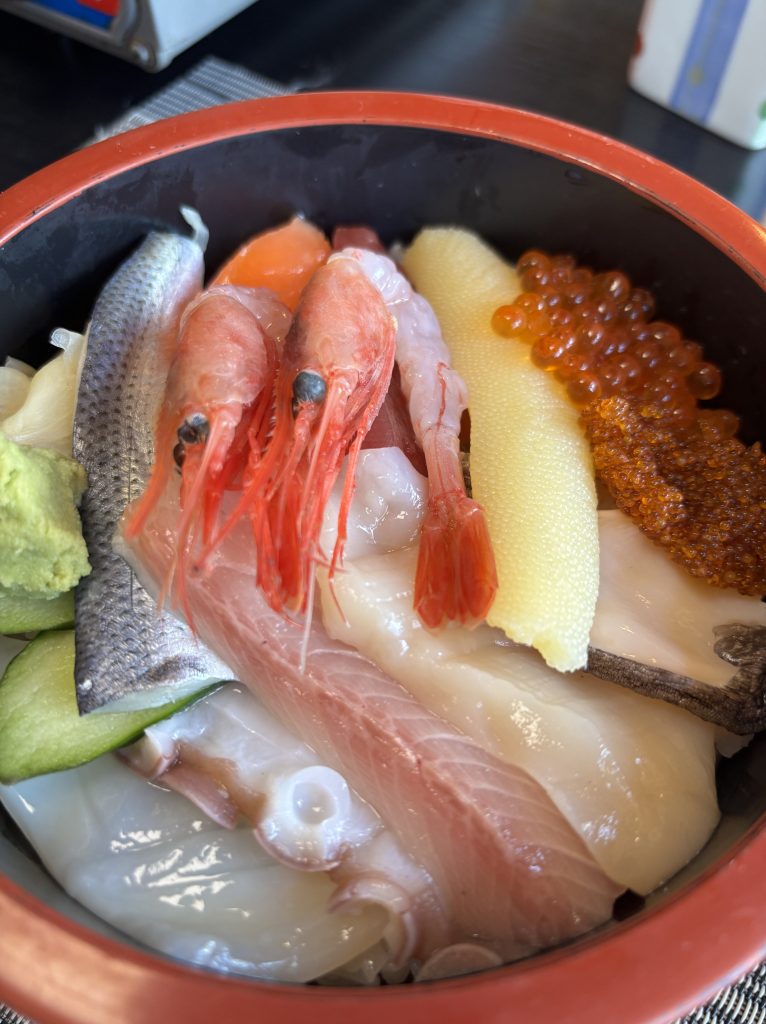
Almost every bite produced some variation of the same reaction: Why is this so good?
The seafood was sweet and clean, with none of the muddiness or fishiness that can make a large bowl of raw seafood exhausting halfway through. Even the hot pot seemed to intensify rather than obscure the individual ingredients.
And then there was the uni.
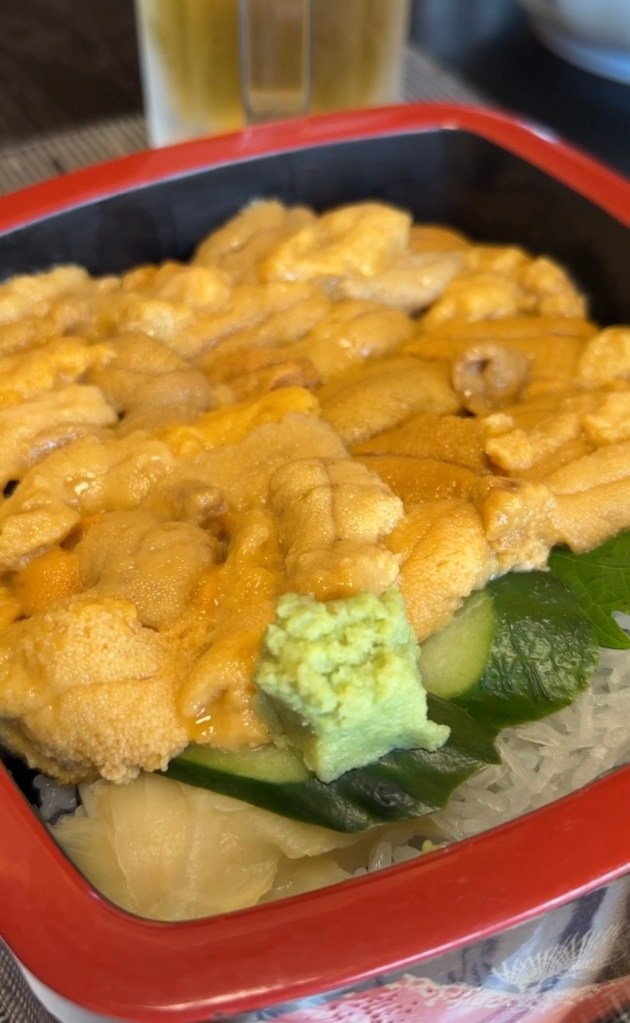
I need to admit something before going further: I had never really liked uni.
I understood intellectually that it was considered a delicacy. I had eaten it in good Japanese restaurants, seen people become excited when it appeared on a menu and paid enough for it to know that I was apparently supposed to appreciate it. But I never understood the obsession. The texture could feel vaguely unpleasant, the flavour sometimes too marine or slightly bitter, and the richness could become tiring very quickly.
I assumed it was simply one of those foods I didn’t particularly like.
The uni in Furubira made me realise that perhaps I had simply never eaten the version that explains why people love it.
Sea urchin from Hokkaido is particularly prized in summer, and the waters around the Shakotan Peninsula are closely associated with both uni and high-quality kombu. Sea urchins feed on kelp and other marine vegetation, and what they eat contributes to the flavour and quality of the roe. The local season is also brief, which makes truly fresh uni a much more geographically and temporally specific experience than its appearance on international sushi menus might suggest.
I’ll come back to that in a separate piece, because I left Hokkaido curious about how this peculiar orange food became one of the world’s luxury ingredients.
For now, what mattered was the taste.
Raw, it was soft without becoming mushy, creamy without feeling heavy, and intensely savoury without tasting fishy. There was sweetness, but also something deeper and more persistent — a marine umami that seemed to expand rather than disappear after the bite was gone.
Then I tasted it in the hot pot.
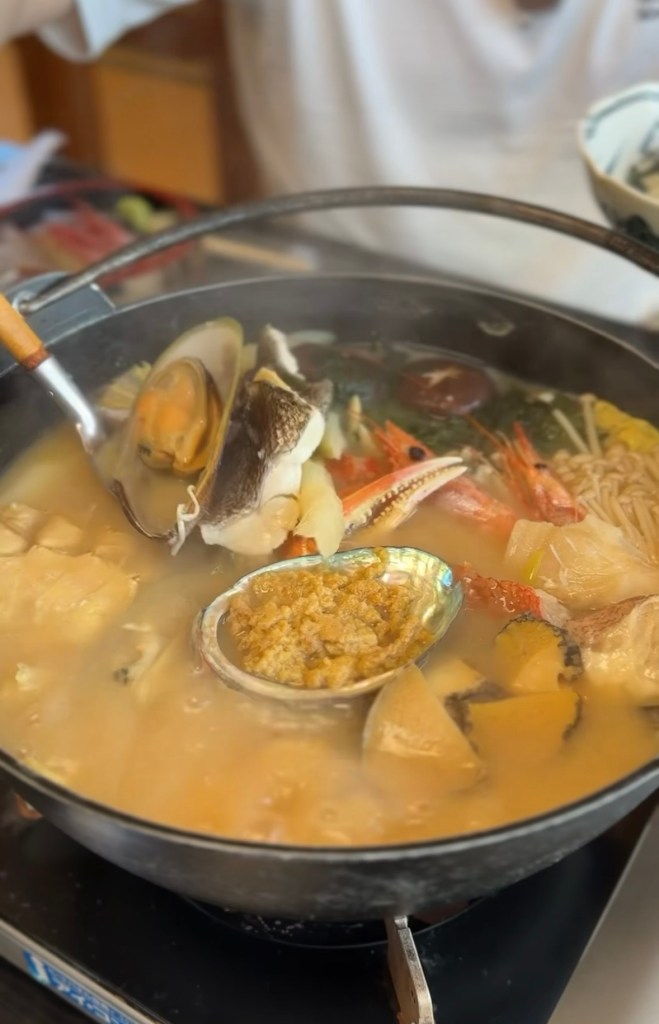
Even cooked, the uni retained that depth, melting into the broth and making everything around it taste richer without announcing itself as a separate ingredient.
It reminded me of the first time I properly understood truffles. Before that moment, the price and reverence can seem faintly irrational; afterwards, you understand that people aren’t paying simply for more flavour. They are paying for a flavour that is unusually difficult to replace with anything else.
For the first time, uni made sense to me.
And then, melon
After seafood, uni, hot broth and rice, dessert arrived looking almost comically simple: watermelon and melon.
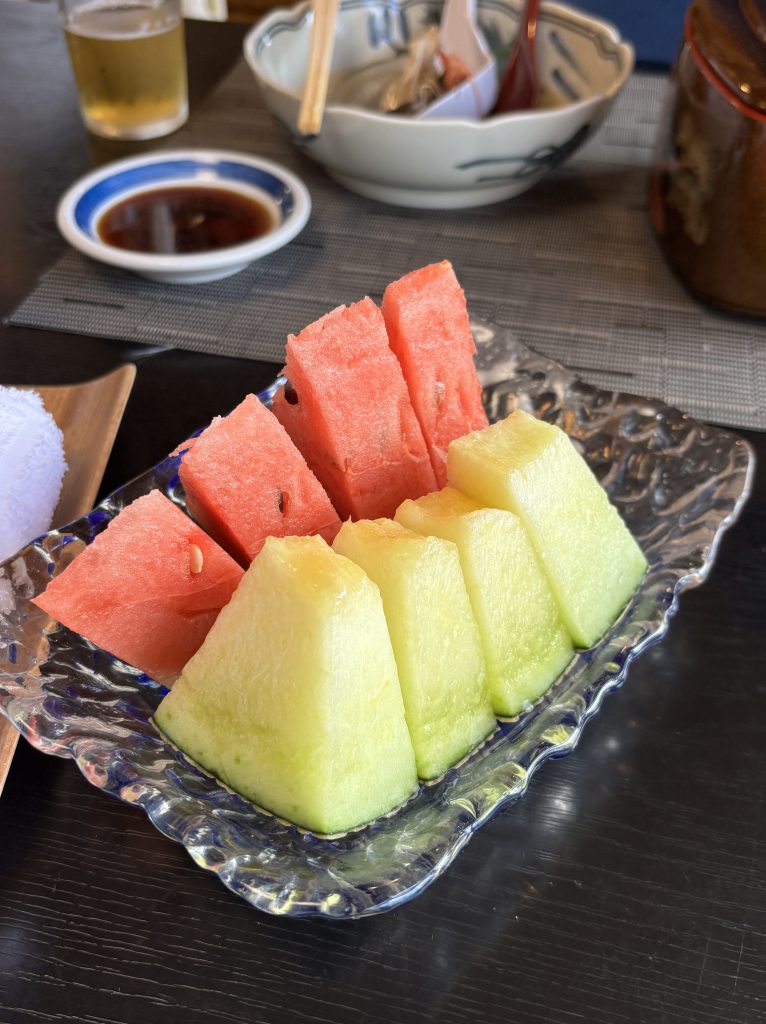
The watermelon was excellent, but the melon was the one I kept thinking about.
Japanese melons occupy a strange place in the country’s gift culture, with perfect specimens sometimes selling for extraordinary prices, and I had always understood the phenomenon more as cultural curiosity than culinary necessity. The slice in front of me was not one of those auction melons. It was simply dessert at a local restaurant.
Yet its texture was almost impossibly soft without being overripe, and the sweetness arrived with so much juice and freshness that it seemed to clean away the richness of everything we had just eaten. It was delicate rather than sugary, fragrant rather than merely sweet.
Again, the ingredient was doing most of the work.
What affected me wasn’t that Hokkaido could produce luxurious food. I already knew that.
It was that this level of produce seemed woven into ordinary eating.
We weren’t sitting at a Michelin-starred counter. We weren’t eating a special menu designed to demonstrate Hokkaido terroir to foreign visitors. We were in a restaurant where local people ate, being served food that made sense because of where we were.
There is a particular kind of pride embedded in that, one that doesn’t require much explanation.
A vineyard where I hadn’t expected one
After lunch, the landscape changed again.
We stopped at OcciGabi Winery in Yoichi, and for a moment Hokkaido seemed to have transported us somewhere entirely different.
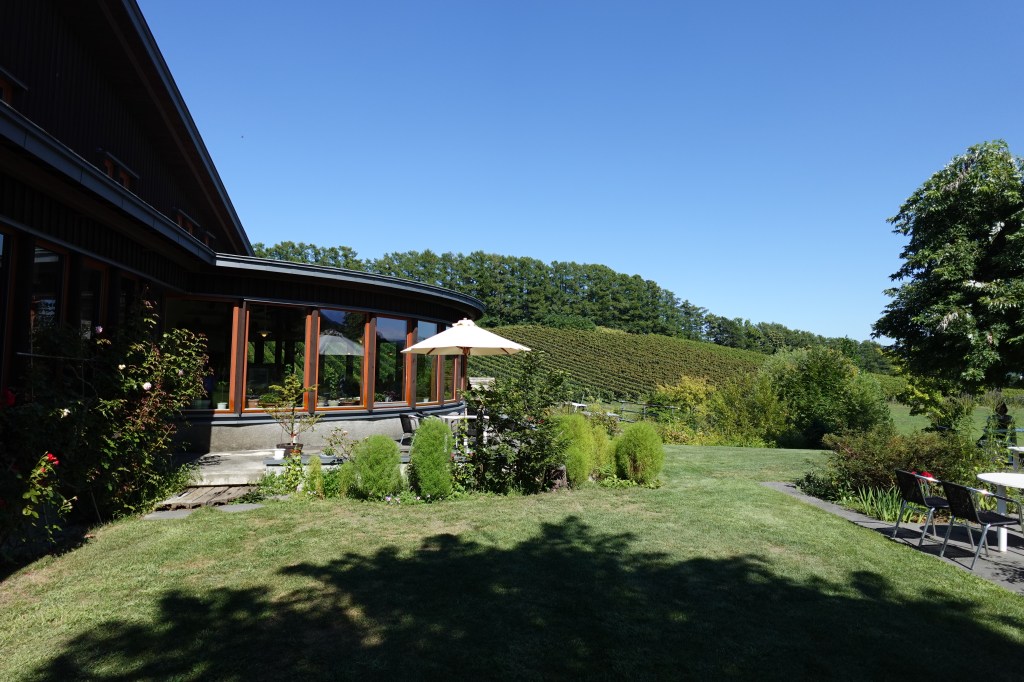
The winery sits among gently rolling vineyards and gardens, with a restaurant and winery complex looking out across rows of vines. Yoichi has emerged as one of Hokkaido’s important wine areas, benefiting from the island’s cool climate and a growing community of producers experimenting with European grape varieties.
What surprised me wasn’t simply that Hokkaido produced wine; I knew that before arriving. It was how naturally the landscape accommodated it.
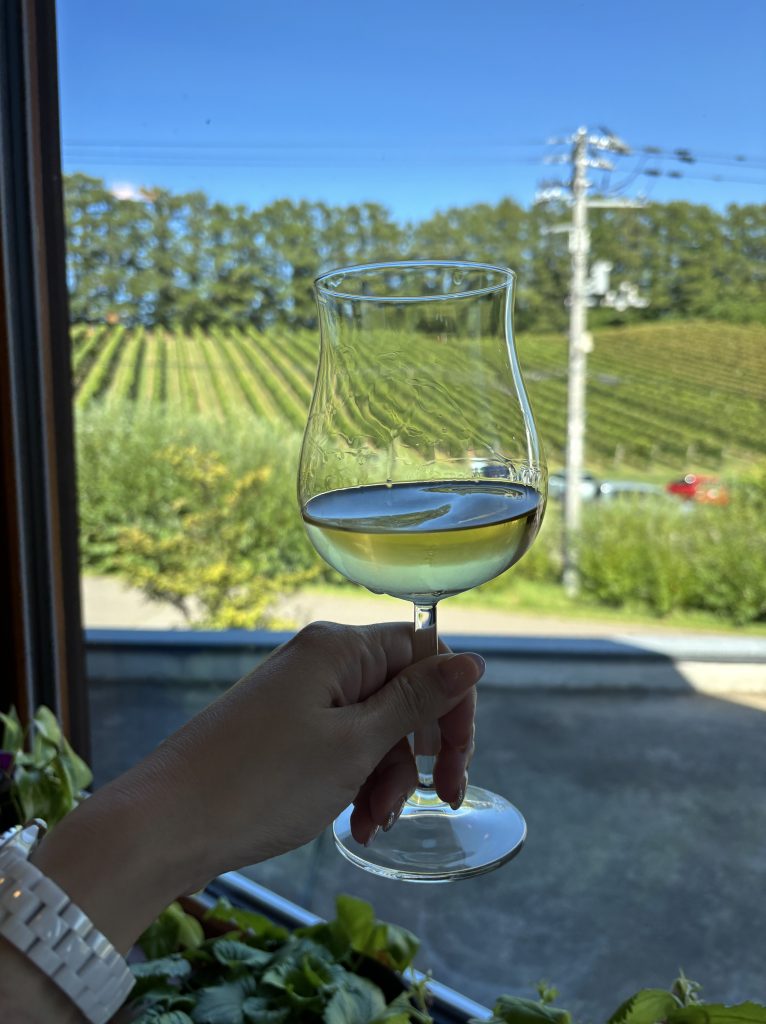
Sitting there with a glass of wine, looking across the vines under an enormous blue sky, I could have imagined myself briefly transported to a quieter corner of Napa. There was the same combination of agriculture and leisure, the feeling that the pleasure of drinking the wine was inseparable from seeing where it had come from.
The comparison wasn’t exact, nor did it need to be. What interested me was discovering yet another version of Hokkaido I hadn’t associated with the island before this trip.
Within a single day we had moved from fishing villages and dramatic coastline to sea urchin, melon and vineyards.
The itinerary had contained relatively few conventional attractions, and somehow that had become its strength.
Back to Yotei
The drive back to Niseko took roughly an hour and a half.
By then the landscape that had seemed strangely empty when we first arrived felt different to me. The farms, forests, small towns and stretches of road between destinations no longer felt like spaces separating the things worth seeing. They had become part of what I had come to understand about the place.
Back at MUWA, we had reserved a private onsen.
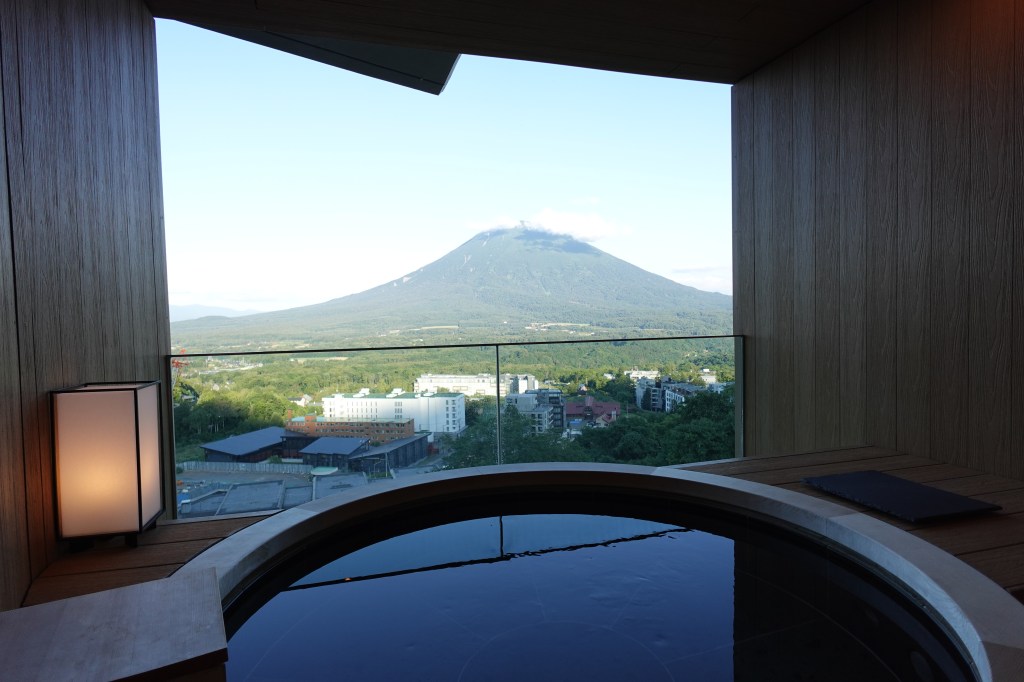
Mount Yotei filled the view beyond the bath.
After eight hours of driving, walking, eating and listening, sitting in hot water with the mountain directly in front of me felt almost absurdly luxurious. Not because the bath itself was elaborate, but because by then Yotei had become a kind of constant presence in the trip. It had appeared beyond Lake Shikotsu, followed us around golf courses, emerged between roads and fields, and now sat perfectly framed in front of the water.
For once, there was nowhere else I wanted to be.
Dinner tasted different that night
We finished the day at Kumo Restaurant in Skye Niseko, next door to MUWA, with another course dinner built around Hokkaido ingredients.
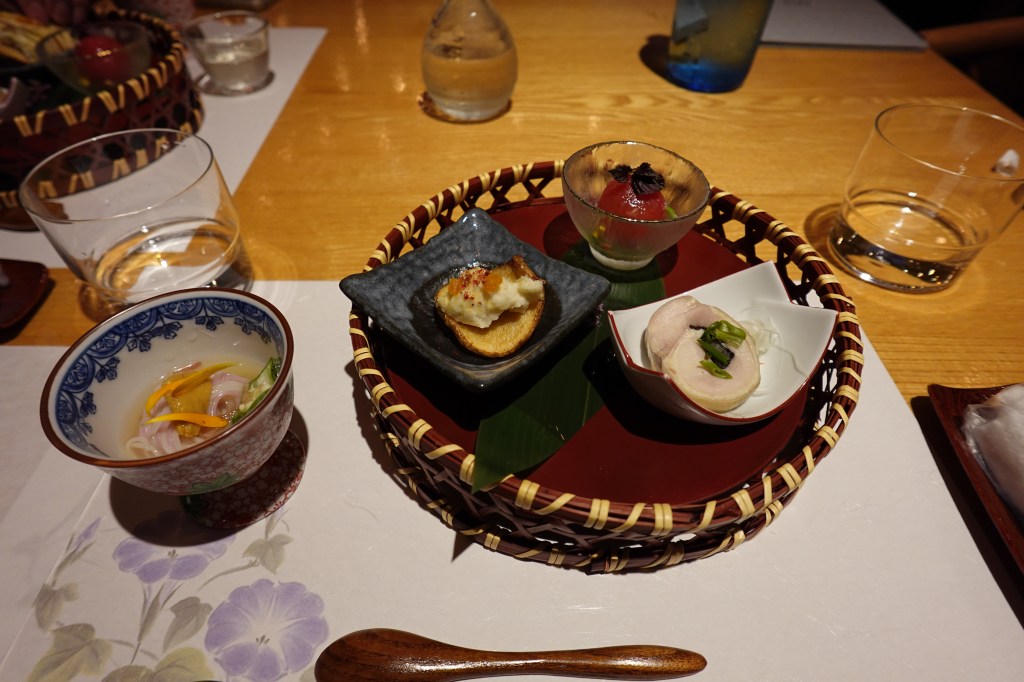
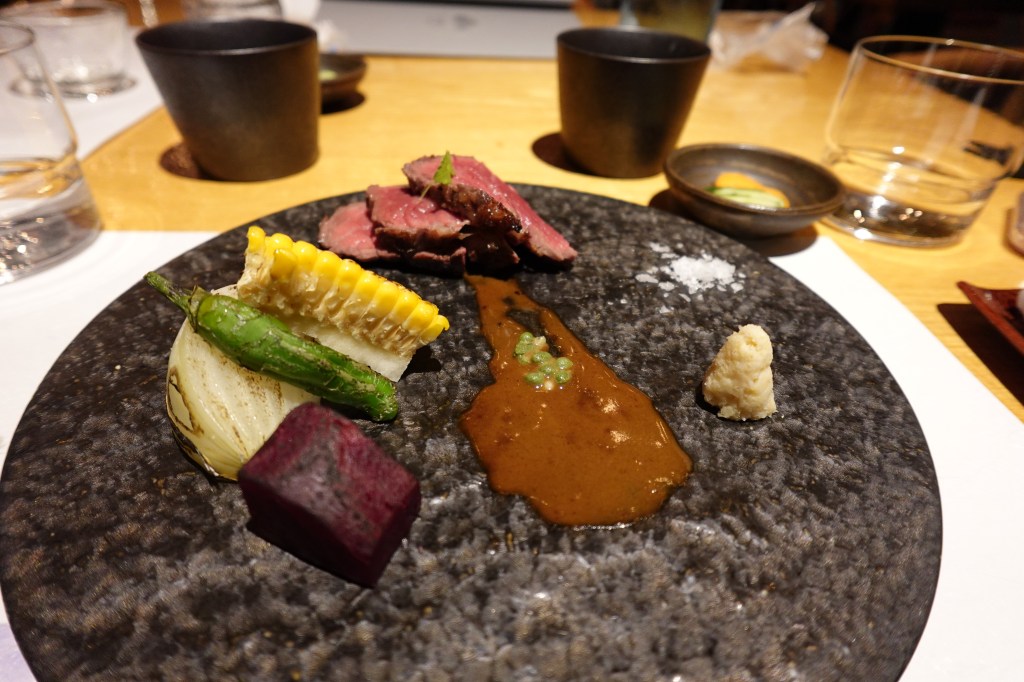
Had we eaten the same meal two nights earlier, I would probably have described it as very good modern Japanese food.
That evening I noticed different things.
I noticed the corn.
I thought about where the vegetables had been grown. I paid more attention to the sweetness and texture of the produce and to how little some ingredients needed to be manipulated. The meal hadn’t necessarily changed; I had.
There is a difference between being told that a restaurant uses local ingredients and spending a day travelling through the places those ingredients come from. Once you’ve eaten corn straight from a local farm, uni near the coast where it was harvested and melon in an ordinary regional restaurant, the phrase Hokkaido ingredients stops being a line on a menu.
It becomes geography.
The summer Niseko I hadn’t known existed
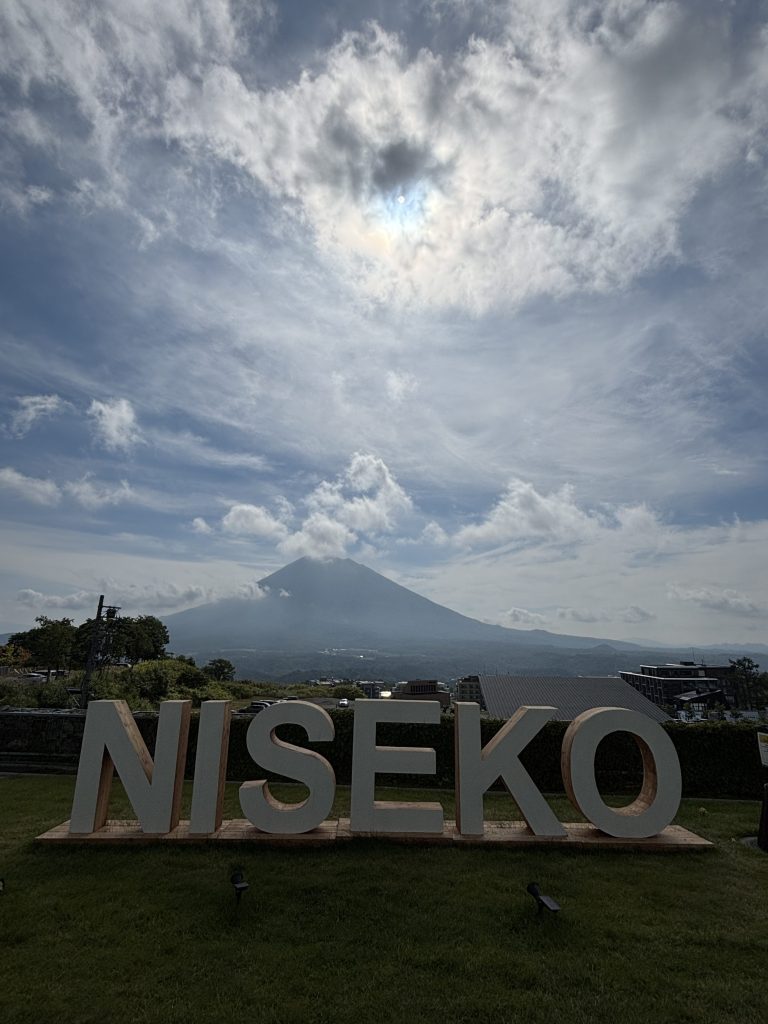
Before this trip, Niseko occupied a very small space in my imagination.
It was a luxury ski destination. An excellent one, presumably, but still a place whose reason for existing seemed tied to snow.
Three nights in August didn’t make me an expert on Hokkaido, and I don’t think I want to pretend that they did. If anything, the trip had the opposite effect. It made the region feel much larger than I had understood.
What stayed with me wasn’t a single spectacular attraction. It was the accumulation of smaller discoveries: Lake Shikotsu appearing beyond the trees; Mount Yotei repeatedly finding its way back into view; an afternoon on a golf course; fishing boats along a coast that wasn’t trying to become a resort; corn sweet enough to make me question whether sugar had been added; the first uni I genuinely loved; melon after lunch; a vineyard I hadn’t expected; hot water and a mountain at the end of the day.
I had come expecting to heal, in the rather vague way we use that word when we mean we are tired and would like someone else to cook for us for a few days.
Instead, I left wanting something more specific.
I wanted to come back slowly.
Not necessarily to stay in another luxury hotel or repeat the same itinerary, but to spend longer in the smaller towns, to learn what grows where and when, to buy ingredients locally and cook with them, to understand the seasons rather than simply arrive for whichever one happens to suit my calendar.
Most of all, I found myself imagining doing that with my child someday: staying somewhere for a few weeks rather than a few nights, buying corn and vegetables from local farms, learning how people cook them, returning to the same shops, watching the landscape become familiar instead of merely beautiful.
It is rare for a short trip to leave me wanting not simply to return, but to learn how to live there for a little while.
Niseko did.
I went because I happened to have the opportunity, because Hokkaido would be cooler than the cities farther south, because there was a good hotel and a golf course.
I left with a place added to that very short list of destinations I know I will return to.
And strangely enough, it was summer — not snow — that put it there.


Leave a comment