We are told to moisturize, constantly. Morning and night. After retinol. Before sunscreen. On damp skin. With ceramides, perhaps, or hyaluronic acid, or something expensive fermented in a laboratory in Switzerland. But there is a surprisingly basic question underneath all of this: how much moisturizer does our skin actually need?
For years, I thought of moisturizer as the least interesting part of skincare.
Serums contained the clever things. Retinoids did the serious work. Acids resurfaced, vitamin C brightened, peptides promised vaguely futuristic interventions in collagen. Moisturizer was what you put on afterwards so your face did not feel tight.
And yet, the older I get—and the more I read about how skin actually functions—the more I have come to think of moisturizer as one of the great foot soldiers of skin ageing. Not glamorous. Not miraculous. Not a substitute for sunscreen, which remains our most important defence against photoageing. But indispensable precisely because it is doing something far less dramatic and far more fundamental: helping the outermost layer of our body remain a functioning barrier.
The American Academy of Dermatology places sunscreen and moisturizer together among the basic products from which an anti-ageing routine should begin. Moisturizer can temporarily soften the appearance of fine lines, certainly, but its more interesting job is structural: supporting the water content and integrity of the stratum corneum, the very thin outer layer standing between us and the world. (American Academy of Dermatology)
Which left me with a question that sounds absurdly simple and turns out not to be.
How much moisturizer do we actually need?
Not “whatever feels right.” Not “a pea-sized amount,” because peas are not a scientific unit. And not “as much as your skin wants,” because skin, regrettably, does not speak.
So I went looking for a more useful answer.
1. Moisturizer may be the least glamorous anti-ageing product I own

There is an important qualification to make before giving moisturizer too much credit.
If the objective is preventing premature skin ageing, sunscreen matters more. Chronic ultraviolet exposure is a major driver of photoageing, and randomized clinical evidence has shown that regular sunscreen use can slow visible skin ageing. (Hughes et al., Annals of Internal Medicine, 2013)
Retinoids have a separate and better-established role in treating fine lines, pigmentation and texture by affecting cell turnover and collagen biology.
Moisturizer does neither of those things.
It does not block ultraviolet radiation unless it also contains adequate sunscreen. It does not remodel collagen in the way prescription retinoids can. What it does is less spectacular: it helps keep water where water belongs.
This sounds cosmetic until one remembers that our skin is, among other things, a remarkably sophisticated water-management system.
The surface of our body is constantly losing water to the environment through a process called transepidermal water loss, or TEWL. A healthy stratum corneum slows that escape. When the barrier is disrupted, water escapes more easily; skin becomes rougher, tighter and more vulnerable to irritation.
Age complicates this further. Research on ageing skin shows alterations in epidermal barrier homeostasis, reduced integrity of the stratum corneum and slower barrier recovery after disruption. The exact relationship between chronological age and baseline TEWL varies by body site, sex and population, but the broader finding is more consistent: older skin becomes less efficient at recovering when its barrier is challenged. (review on ageing and epidermal function)
So perhaps moisturizer is better understood not as an anti-wrinkle treatment but as maintenance infrastructure.
You still need the roof—sunscreen. You may decide to renovate the building—retinoids, procedures, whatever else you choose. But none of that makes maintaining the walls optional.
2. Why does water matter so much to skin?
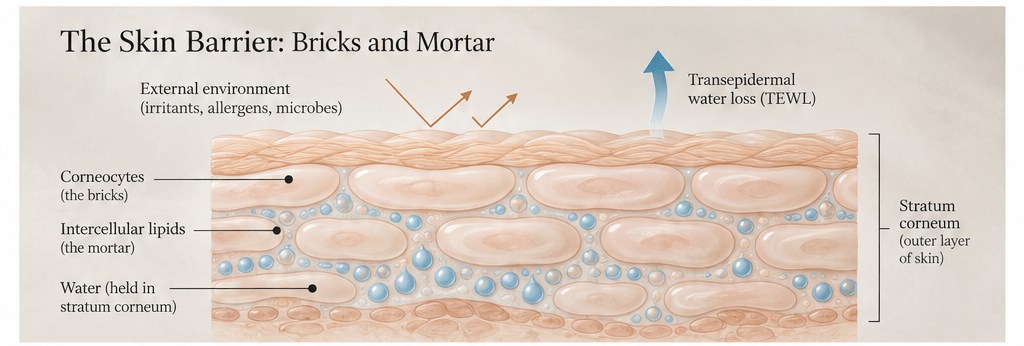
The outermost layer of skin is often described using the rather charming “bricks and mortar” analogy.
The bricks are corneocytes: flattened, mature skin cells.
Between them sits the mortar, a highly organized lipid matrix containing ceramides, cholesterol and fatty acids. Inside the corneocytes are substances collectively known as natural moisturizing factors, or NMFs, which attract and hold water.
This arrangement has to perform two contradictory jobs at once. It must prevent too much of our internal water from escaping while also protecting us from irritants, allergens and microbes outside. A detailed review of skin-barrier physiology describes this structure and the role of stratum-corneum lipids, corneocytes and water in maintaining barrier function. (Skin Barrier Physiology review)
Water changes the physical behaviour of this layer.
A well-hydrated stratum corneum is more flexible. The enzymes involved in normal shedding work properly. The surface appears smoother because dry, partially detached cells are less conspicuous. When hydration falls, the same surface becomes rougher and more brittle, and microscopic fissures become easier to form. Reviews of moisturizer physiology describe improvements in hydration, flexibility and barrier function when these mechanisms are properly supported. (Purnamawati et al., review of moisturizer function)
This also explains one of moisturizer’s quickest beauty tricks.
Dehydrated fine lines look deeper.
Add water to the stratum corneum and reduce its evaporation, and the superficial surface swells slightly. Light reflects differently. Tiny furrows become less obvious. The American Academy of Dermatology notes that moisturizing can reduce the appearance of some fine lines and make the complexion look brighter. (AAD on wrinkle remedies)
That word—appearance—matters.
Hydrating a wrinkle is not the same biological process as rebuilding dermal collagen. Moisturizer can make a dry crease look substantially better without having “reversed ageing.” This is not a reason to dismiss it. It is simply a reason to understand what it is doing.
There are very few situations in skincare in which understanding the mechanism makes the product seem more useful rather than less.
Moisturizer is one of them.
3. Moisturizer does not simply “put water into your skin”
This was probably my largest misconception.
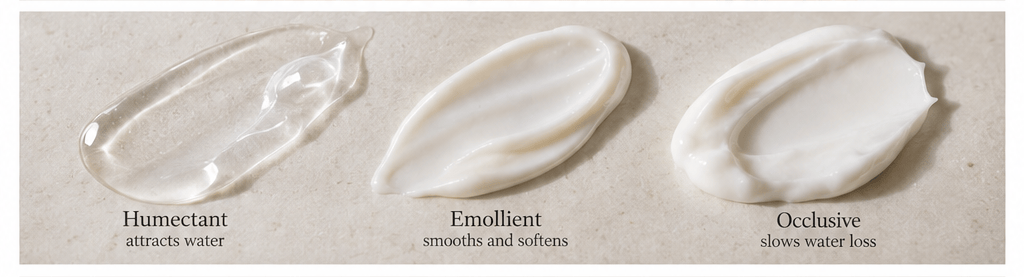
A jar of moisturizer is not, essentially, a container of water that we paint onto ourselves. The useful formulations tend to combine three families of ingredients, often with considerable overlap between them.
Humectants attract water.
Think glycerin, urea, hyaluronic acid, panthenol and sodium PCA.
They are hygroscopic: they bind water and help increase water content in the stratum corneum. Glycerin is particularly unglamorous and particularly good at its job.
Occlusives slow water loss.
Think petrolatum, mineral oil, silicones and certain waxes and lipids.
They form a more water-resistant film over the surface, reducing evaporation.
Emollients smooth the spaces between cells.
They improve flexibility and texture by filling microscopic irregularities in a dry surface and making it feel softer.
The best moisturizers are therefore often less like a single hero ingredient and more like a small engineering team.
One randomized crossover study in people with dry skin illustrates the point beautifully. Petrolatum primarily improved barrier function by reducing TEWL; glycerol primarily improved hydration. The complete emollient formulation, containing both, produced the combined effect. (randomized crossover study on glycerol and petrolatum)
It is one reason I have become increasingly suspicious of skincare marketed around a single photogenic ingredient.
“Hyaluronic acid moisturizer” tells us very little about whether the entire formula is actually good at moisturizing.
Ceramides deserve slightly different attention because they resemble lipids naturally present in the stratum corneum. A review of controlled clinical studies found evidence that ceramide-containing formulations can improve water retention and barrier function, particularly in dry and barrier-impaired skin, although formulations and study populations vary considerably. (review of ceramide-containing formulations)
The lesson is not that everyone needs ceramides.
It is that formulation matters more than ingredient celebrity.
4. So: how much moisturizer do we actually need?
Here, finally, science provides something more useful than “a pea-sized amount.”
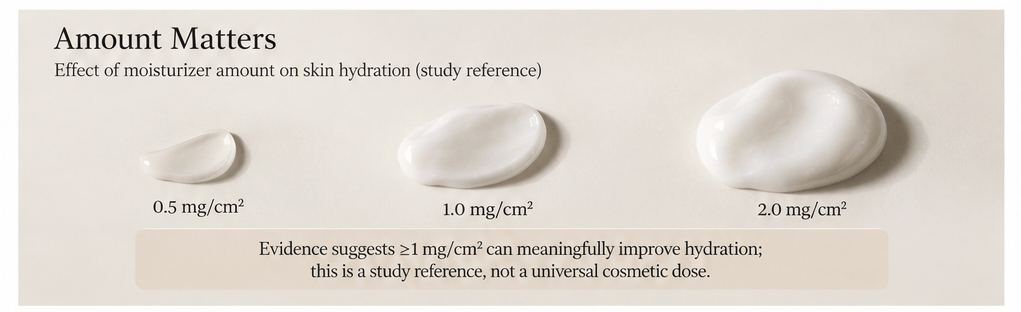
A study specifically tested moisturizer timing, quantity and frequency by comparing applications of 0.5, 1.0 and 2.0 milligrams per square centimetre of skin. The researchers found that 1.0 mg/cm² and 2.0 mg/cm² increased stratum-corneum water content significantly, and concluded that applying at least 1.0 mg/cm² twice daily produced the most useful physiological effect in their study. (Murakami et al., Journal of Cosmetic Dermatology)
There are caveats. The study was relatively small, evaluated specific products and skin sites, and several authors were employees of the manufacturer. It gives us a useful physiological reference point, not a universal cosmetic commandment.
But it tells us something important:
The answer is probably more than the tiny ceremonial dab many of us use.
There is no clinically established amount of moisturizer that has been proven to “prevent ageing.” No trial has established that 0.7 grams of cream preserves a specific percentage more collagen than 0.3 grams, because that is not really moisturizer’s biological job.
The practical goal is instead to apply enough product to create a thin, continuous layer over the entire area you intend to moisturize.
Not dots on the forehead and cheeks that disappear before reaching the jaw.
Not so much that a centimetre of cream remains sitting visibly on the face.
Enough that, after spreading, the skin feels comfortably coated and supple rather than merely having encountered moisturizer somewhere during the evening.
The dermatological concept of a fingertip unit helps put quantities into perspective. One adult fingertip unit is roughly 0.4–0.5 grams of topical cream, although the system was developed primarily to standardize medication dosing rather than cosmetic skincare. DermNet estimates approximately 2.5 fingertip units for the entire face and neck when treating those areas with a topical preparation. (DermNet: Fingertip Unit)
I would not turn that into a rule requiring 2.5 fingertip units of facial cream every night. Different moisturizers spread very differently, and medication dosing is not interchangeable with cosmetic use.
Instead, it gives us a reality check.
A smear barely covering the tip of one finger may not be the abundance we imagine it is.
My practical rule
For facial moisturizer, forget the pea.
Dispense enough to cover face, jawline and—if that is part of your routine—neck in one even film without having to drag the product across dry skin.
If half your face has absorbed it before you have reached the other half, use slightly more.
If your face remains heavily coated and uncomfortable ten minutes later, use less or choose a lighter formulation.
The correct endpoint is coverage, not a predetermined blob.
5. How often should we moisturize—and when?
This part of the evidence is more satisfying.
Twice daily is a reasonable default for dry, normal or ageing skin, particularly when the skin barrier is being challenged by cleansing, climate, retinoids or other active ingredients.
In the moisturizer application study above, twice-daily use over eight weeks produced stronger physiological changes in dry skin than once-daily use. (Murakami et al.)
That does not mean oily skin must endure a heavy cream morning and night. Frequency and vehicle can be separated: a light lotion or gel-cream in the morning and a richer product at night may accomplish the same practical goal.
More important than some perfect clock time is what has just happened to your skin.
Washing is one of the moments when moisturizer matters most.
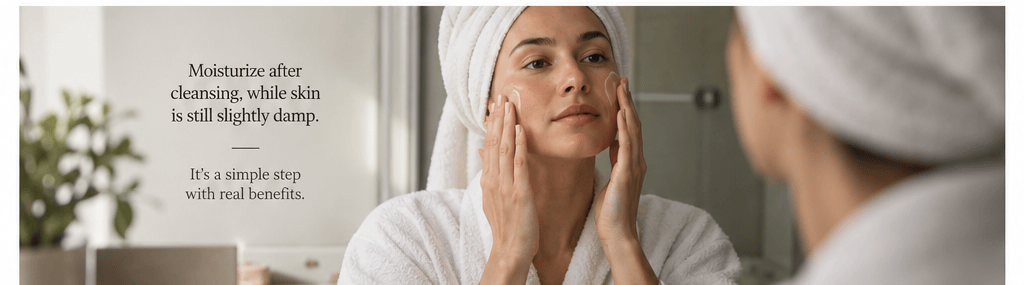
Dermatologists routinely recommend applying moisturizer soon after bathing or washing, while the skin is still slightly damp. The purpose is not mystical absorption through “open pores.” It is simply a very good time to slow evaporation of water already present in the stratum corneum. (AAD: Dermatologists’ tips for relieving dry skin)
The application study also found better hydration when moisturizer was applied within five minutes of bathing rather than 90 minutes later. (Murakami et al.)
So the much repeated advice to moisturize damp skin turns out to be one of those rare skincare rules that survives contact with the literature.
There is no need to race from the shower dripping wet.
But neither is there much advantage in allowing your freshly washed face to become completely dry and tight before remembering the moisturizer sitting beside the sink.
6. What kind of moisturizer should you use?
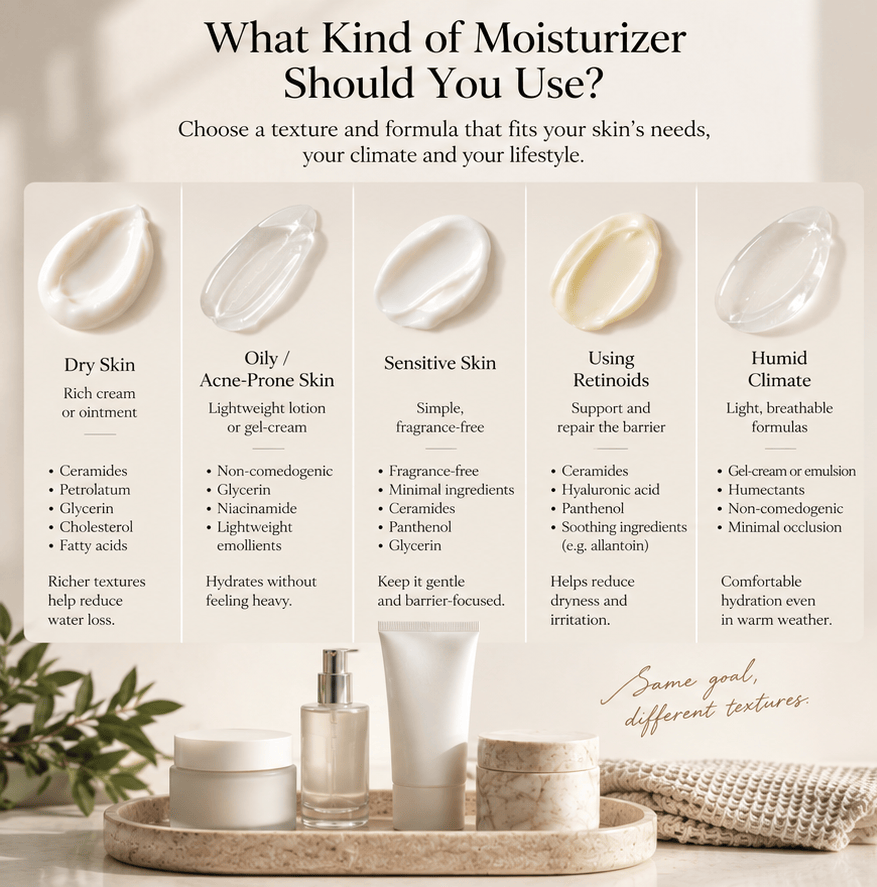
This is where skincare becomes personal—but not in the meaningless “everyone is different” way.
There are actual variables.
If your skin is dry
Favor a cream or ointment over a very fluid lotion, particularly at night.
The American Academy of Dermatology recommends creams and ointments for dry skin because they are generally more effective at reducing water loss than lighter lotions. Petrolatum-containing products remain remarkably effective despite possessing none of the romance of a rare alpine botanical. (AAD dry-skin guidance)
Look for combinations of humectants and barrier-supportive or occlusive ingredients rather than chasing one fashionable molecule.
Useful names include:
glycerin, ceramides, petrolatum, dimethicone, hyaluronic acid, panthenol, squalane, cholesterol and fatty acids.
You do not need all of them.
If your skin is oily or acne-prone
You still have a skin barrier.
Choose a lighter, non-comedogenic lotion, emulsion or gel-cream that you will actually use consistently. Heavy occlusion is not automatically superior if it makes you uncomfortable or encourages you to abandon the routine entirely.
If your skin is sensitive
Boring is often excellent.
Fragrance is a frequent source of irritation, and dermatologists commonly recommend fragrance-free products for dry and sensitive skin. “Unscented” is not necessarily the same thing: a product can contain ingredients intended to mask its underlying smell. (AAD dry-skin guidance)
If you use retinoids
Moisturizer becomes more rather than less important.
Retinoids can produce dryness and irritation, particularly during introduction. Dermatologists may recommend using moisturizer before or after a retinoid depending on tolerance and the formulation being used. (AAD skin-care guidance)
A skin barrier that is chronically irritated in pursuit of anti-ageing is not evidence that the routine is working harder.
It is often evidence that the routine is working badly.
And if you live somewhere humid?
Humidity changes how skin feels, but it does not repeal skin physiology.
You may need less occlusion and a lighter vehicle than someone spending winter beside a radiator in Stockholm. Humectant-rich emulsions can feel much more comfortable than petrolatum-heavy creams in tropical weather.
The question is not whether a moisturizer feels rich enough to qualify as serious skincare.
It is whether your skin remains comfortable, flexible and free from persistent tightness, flaking or irritation between applications.
7. The anti-ageing moisturizer routine I would actually follow
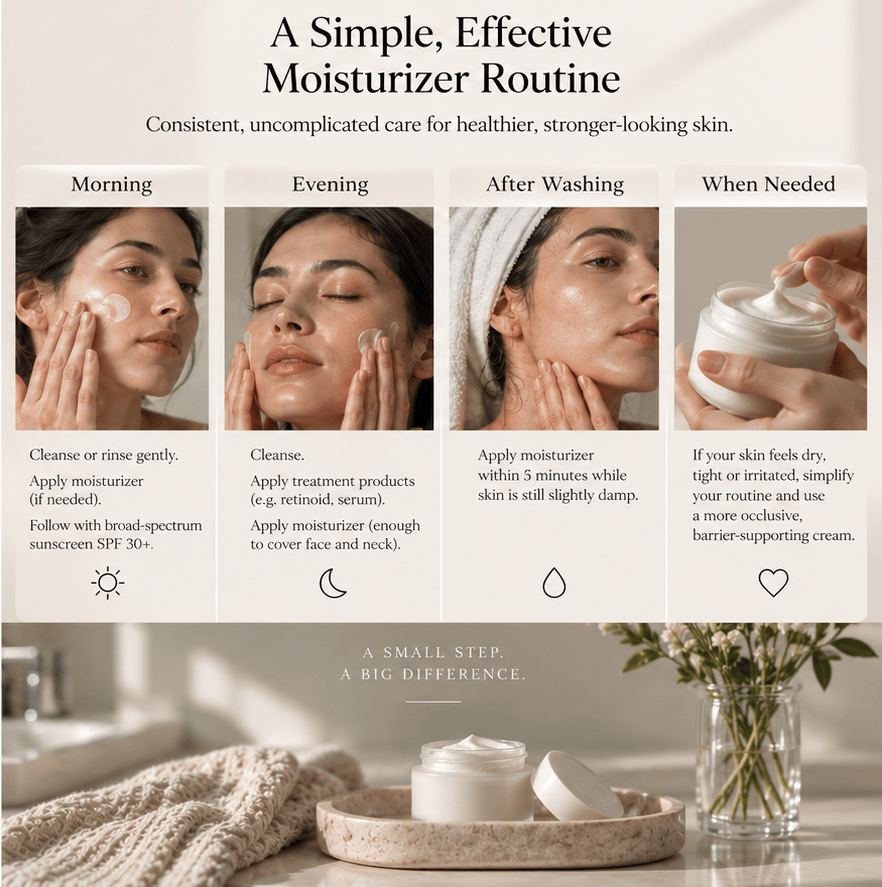
After reading all of this, my routine became simpler rather than more complicated.
Morning: wash gently—or simply rinse if cleansing is unnecessary—then apply a light moisturizer in a continuous layer if my skin needs it. Follow with broad-spectrum SPF 30 or higher in an adequately applied amount. Sunscreen remains the non-negotiable anti-ageing step. (AAD guidance for skin in your 40s and 50s)
Evening: cleanse without stripping the skin. Apply treatment products as appropriate. Then use enough moisturizer to cover the entire face and neck comfortably rather than rationing an expensive cream into microscopic dots.
After washing: do not deliberately wait until the skin becomes tight. Moisturize while it retains some surface hydration. (AAD dry-skin guidance)
When irritated or unusually dry: simplify. Reduce unnecessary exfoliation and irritating actives, and temporarily favor a more occlusive barrier-supporting cream.
When perfectly comfortable: resist the skincare industry’s ability to persuade us that every stable situation represents an untreated problem.
And perhaps most importantly, I would stop asking whether my moisturizer contains the newest ingredient and ask three less exciting questions instead:
Does it contain a sensible combination of humectant, emollient and barrier-supporting ingredients?
Am I applying enough of it to cover my skin properly?
Am I using it consistently enough to matter?
The answers are almost embarrassingly mundane.
That may be why moisturizer has never achieved the cult status of retinol.
It offers very little theatre.
No tingling to suggest transformation. No peeling to prove potency. No before-and-after mythology in which a previously undiscovered molecule reorganizes the human face within fourteen days.
Instead, every morning and every night, it performs the same quiet task: helping the outermost fractions of a millimetre of our body hold onto the water they require to function properly.
We spend a remarkable amount of money trying to convince skin to become something new.
Moisturizer is the product that helps it continue doing what healthy skin was designed to do in the first place.
And maybe that is why, somewhere between all the serums and devices and ingredients that arrive each year promising the future, the plain jar of cream beside them has become one of the products I take most seriously.
8. Is Moisturizer Enough?
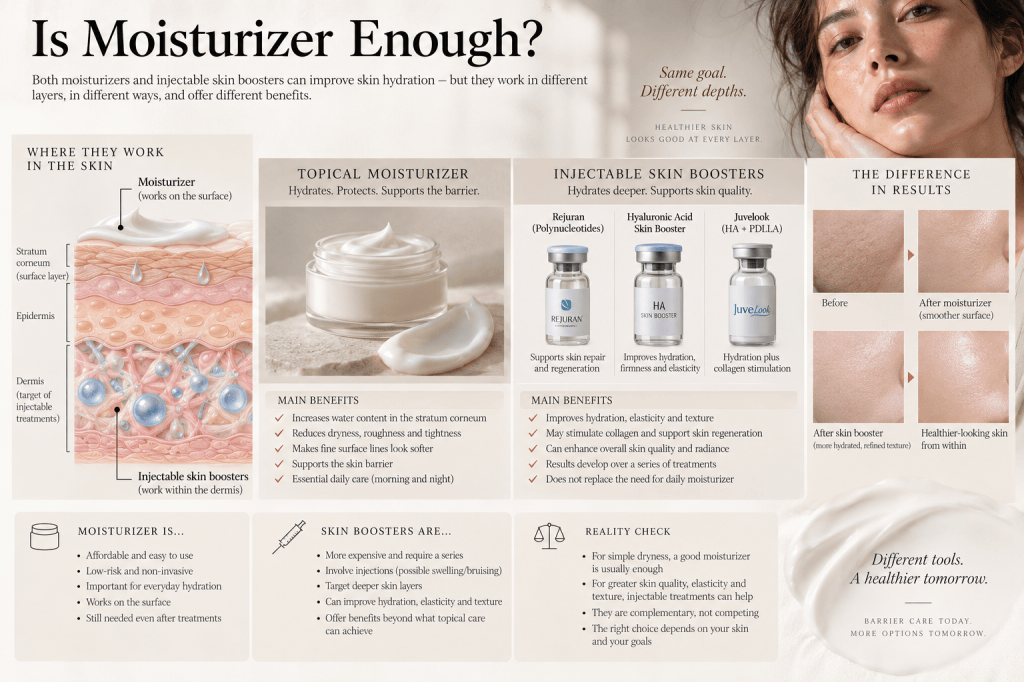
There is, however, another version of this question that has become increasingly difficult to ignore, particularly in Korea and other parts of Asia where “skin boosters” have become almost as routine as facials: if the goal is simply better-hydrated, healthier-looking skin, is there really a reason to inject products such as polynucleotides, hyaluronic acid or collagen-stimulating materials when a good moisturizer is already designed to keep skin hydrated?
The answer is that the two are not quite doing the same thing. Moisturizer works primarily in the stratum corneum, improving the skin’s ability to retain water and reducing the roughness, tightness and fine surface lines that appear when that outer barrier becomes dehydrated. Injectable skin boosters place material directly into the dermis, where the intention is not merely to stop water escaping from the surface but to alter the quality of the deeper skin itself. Injectable hyaluronic acid, for example, has shown improvements not only in hydration but also in firmness, texture, radiance and elasticity across clinical studies, although the evidence base is still relatively small and protocols vary considerably. (systematic review of injectable hyaluronic acid for skin quality)
Polynucleotide treatments—the category that includes products such as Rejuran—are somewhat different again. They are marketed less as injectable moisturizers than as regenerative treatments, with proposed effects on tissue repair and dermal quality. The clinical evidence is promising but considerably less mature than the popularity of the treatment might suggest: a recent systematic review found improvements in wrinkles, texture and elasticity, while also concluding that the available studies remain small, heterogeneous and generally low to moderate in quality. (systematic review of polynucleotides in aesthetic medicine) A newer review of randomized trials reached a similar conclusion, finding potential benefits in rejuvenation and wound healing but emphasizing that larger, better-standardized studies are still needed. (2026 systematic review of PN/PDRN trials)
Interestingly, when polynucleotides have been compared directly with injectable non-crosslinked hyaluronic acid around the eyes, both improved hydration and elasticity, with polynucleotides showing somewhat greater improvement in some measures such as hydration, roughness and pore volume. The study was small—only 27 participants—but it illustrates why these treatments can produce a quality of “plumpness” or smoothness that topical moisturizer cannot fully reproduce: the intervention is taking place within the dermis rather than simply improving water retention at its surface. (randomized split-face PN vs HA study)
Juvelook occupies another slightly different category because it combines hyaluronic acid with poly-D,L-lactic acid, a biodegradable collagen-stimulating material. Early clinical research on injectable PDLLA has reported improvements in fine wrinkles, texture and other signs of skin ageing together with increases in dermal collagen and elastic fibres, but the published studies remain preliminary and much smaller than the evidence supporting something as ordinary as moisturizer. (preliminary study of injectable PDLLA for skin rejuvenation)
So is any of this actually better for hydration than simply using moisturizer every day? If your skin is dry because its surface barrier is losing water, probably not in the sense that matters most: a skin booster does not remove the need for daily moisturizer, and repeatedly injecting the dermis would be a very elaborate way of solving a problem that a well-formulated cream may already manage extremely well. But if what you are looking for is the combination often described as “skin quality”—subtle plumping, improved elasticity and texture, finer lines and a hydrated appearance that seems to come from deeper in the skin—injectable treatments may produce an effect that topical moisturizer alone cannot.
The trade-off, of course, is significant. A moisturizer is cheap, painless, low-risk and useful every single day; injectable treatments cost considerably more, usually require a series of sessions, produce swelling or bruising in the short term and carry the additional risks that accompany injections. Even among Korean dermatologists who use polynucleotides extensively, a common pattern is three treatments roughly four weeks apart rather than a single permanent intervention, which tells us something important about these procedures: they are maintenance too, just a much more invasive form of it. (survey of 235 Korean dermatologists using PN skin boosters)
For me, that makes the hierarchy quite simple. Moisturizer is the foundation for hydration; a skin booster is an optional intervention for improving skin quality beyond what surface hydration can achieve. If my skin merely feels dry, I would fix the moisturizer before reaching for a syringe. If it is already well hydrated and I still want greater elasticity, smoother texture or that slightly denser, more luminous quality associated with healthy dermal tissue, then treatments such as injectable HA, polynucleotides or collagen stimulators begin to make more sense—not because moisturizer has failed, but because I am asking it to do a different job.
Finding Merope note: This article is for general educational purposes and is not a diagnosis or individualized medical advice. Persistent redness, cracking, itching, eczema or unexplained changes in the skin should be assessed by a qualified clinician.


Leave a comment